
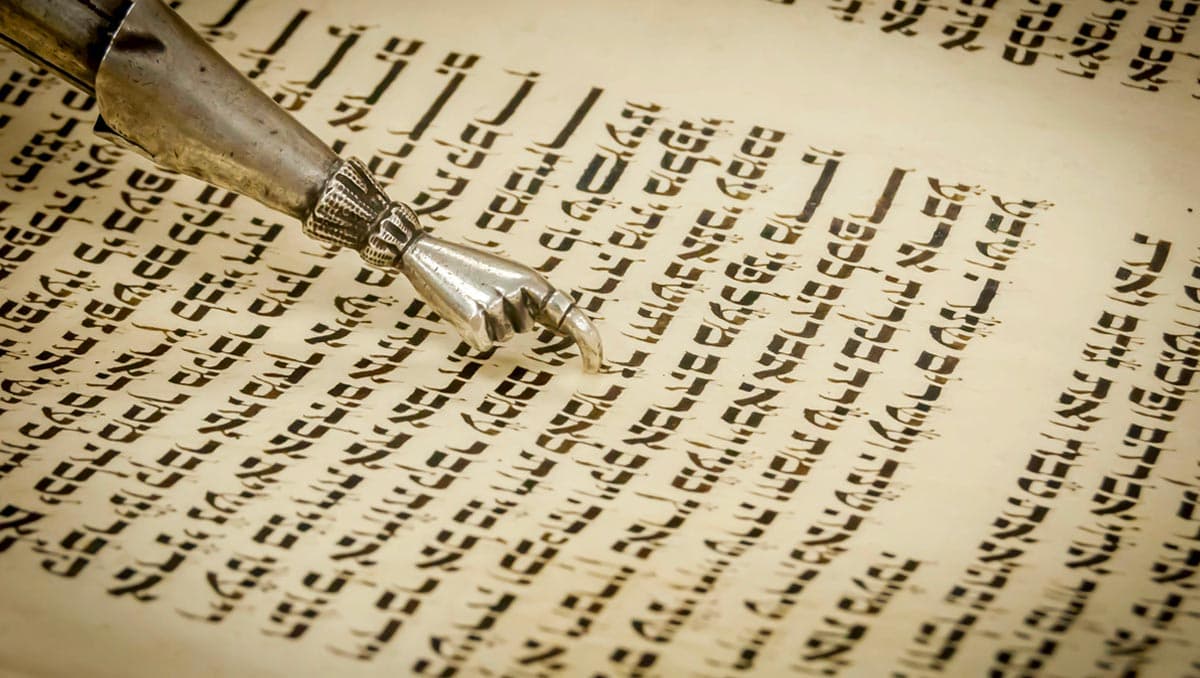
Why Did Jesus Say That God Had Forsaken Him?
Jesus quote from Psalm 22 sheds light on his darkest moment.
by Ruth Rosen |
Many years ago, a Jewish attorney wanted to know more about Jesus, so he agreed to read Jesus’ life story in the New Testament with one of our staff. For months, he met with David Brickner, a Jewish follower of Jesus (Yeshua), to discuss his findings. The outcome of those conversations stuck with David so much that he included the story in a book he wrote decades later, Does the Jewish Bible Point to Jesus?
In what would turn out to be their last conversation about Jesus, the attorney blurted out, “David, now I know that Jesus cannot be the Messiah!”
David responded, “Why is that?”
“Because when he was hanging on the cross. He said, ‘My God, My God, why have You forsaken Me?’1 What kind of a Messiah would say that to God?”
It was a very good question. David’s answer came straight from the Hebrew Scriptures.
Jesus’ Famous Last Words Were From Psalm 22
David pointed to the attorney’s Bible and asked him to read Psalm 22. And there they were, the same words Jesus had said on the cross, coming from King David’s lips: “My God, my God, why have you forsaken me?”2 (“Eli, Eli, lama sabachtani?”)
Yeshua’s question as he hung on the cross was more than a momentary cry of personal anguish; he was echoing the opening of this famous Psalm, written some 1,000 years earlier.
In the midst of his agony, Yeshua drew attention to the psalm that went far beyond King David’s own sufferings, yet was fulfilled in the crucifixion Jesus was enduring.
The attorney was shocked. He had assumed that Yeshua’s words proved that he could not be the Messiah, but further inspection showed that wasn’t the case at all. David says,
It was my turn to be shocked when he responded, “I think Jesus’ followers must have put those words in his mouth to support their own narrative. I don’t believe he said those words at all.”
“Wait,” I said. “You were certain that those words were proof that Jesus couldn’t be the Messiah. Now you don’t believe he actually said them?”
When I called to set up our next meeting, he thanked me and said he had studied enough about Jesus.
A Different Response to the Same Psalm
Around the same time as David was meeting with the attorney,
Asaf (an Israeli) was also meeting with him. Each week they looked at a messianic prophecy from the Jewish Bible. When they got to Psalm 22, Asaf read it in Hebrew as usual—but he kept interrupting himself, saying, “Wow! Wow! Wow!”
What exactly was “wowing” Asaf? David explains it in his book:
The Comparison between Psalm 22 and Yeshua’s Suffering
Look at what the Gospels say about Jesus’ experience and see the
parallels with Psalm 22.
And those who passed by derided him, wagging their heads and saying, “He is the King of Israel; let him come down now from the cross, and we will believe in him. He trusts in God; let God deliver him now, if he desires him … ’” (Matt. 27:39–43)
Compare this to David’s words in Psalm 22:7–8:
“All who see me mock me; they make mouths at me; they wag their heads; ‘He trusts in the Lord; let him deliver him; let him rescue him, for he delights in him!’”
Also:
Then the soldiers, when they had crucified Jesus, took His garments and made four parts, to each soldier a part, and also the tunic. Now the tunic was without seam, woven from the top in one piece. They said therefore among themselves,
“Let us not tear it, but cast lots for it, whose it shall be,” that
the Scripture [Psalm 22:18] might be fulfilled which says:
“They divided My garments among them,
And for My clothing they cast lots.”
Therefore the soldiers did these things.
(John 19:24, emphasis supplied)
The soldiers hadn’t read the Hebrew Bible. They weren’t trying to fulfill the words of Psalm 22, but the parallel is there for all to see. And David uncovers more:
I am poured out like water,
and all my bones are out of joint;
my heart is like wax;
it is melted within my breast;
my strength is dried up like a potsherd,
and my tongue sticks to my jaws;
you lay me in the dust of death.
For dogs encompass me;
a company of evildoers encircles me;
they have pierced my hands and feet—
I can count all my bones—
they stare and gloat over me. (Ps. 22:14–17)
What’s so startling about these words is that King David
recorded them before crucifixion had ever been invented as a form of
execution. And yet, doesn’t it sound like a remarkable description
of what was happening to Jesus on the cross?
The psalm speaks powerfully to the nature of what he experienced in body and soul, both metaphorically and literally. Parts of it are amazingly accurate to his physical experience—including verse 16 (verse 17 in the Hebrew text) “they have pierced my hands and feet.”
On that specific point, there is some controversy, which David speaks to.
Some have debated the translation of verses 16–17 [verses 17–18 in the Hebrew text]. In the Jewish Publication Society translation of Psalm 22, instead of “They pierced my hands and my feet,” it says “like a lion they are at my hands and feet.” The difference between “they pierced” and “like a lion” comes down to whether the original Hebrew text used the letter “yod” or “vav.” They look very similar to each other.
The Septuagint, the Greek translation of the Scriptures, sheds some insight. The Hebrew translators of the Septuagint rendered the word as “they pierced” in the Greek. That gives us an official Jewish understanding of the word at that time.3
So, when David and Asaf reached the end of the Psalm, David began to explain the case for the Hebrew text being “they pierced” rather than “like a lion.” But Asaf said, “David, it doesn’t matter. This psalm is all about Yeshua!” In other words, a dispute over one word in the psalm could not erase the clear parallels throughout the passage.
More than a year later Asaf became a follower of Yeshua. It didn’t happen all at once. It’s one thing to see that the Jewish Bible points to Jesus. It is another to take what Jesus said and did personally—especially his suffering.
Taking Jesus’ Pain Personally
What was Jesus experiencing when he cried out, “My God, my God, why have You forsaken Me?” As David puts it, Yeshua endured the psychological and spiritual pain of being separated from the Father. The Father had allowed the crushing consequences of the sins of the whole world to come down on him. Yeshua willingly suffered under that devastating weight. And he endured it for one reason: so that we would not have to be forsaken.
Psalm 22 shows us what Jesus would experience, but it does not say why. The prophet Isaiah tells us the reason Messiah would suffer, and makes it very personal.
But he was pierced for our transgressions;
he was crushed for our iniquities;
upon him was the chastisement that brought us peace,
and with his wounds we are healed.
6 All we like sheep have gone astray;
we have turned—every one—to his own way;
and the Lord has laid on him
the iniquity of us all. (Isaiah 53:5–6, emphasis supplied)
Jesus was willing to suffer the pain and alienation of our going astray, of our turning away from God—so that God would not turn away from us. He endured violence and hostility so that we could have peace and healing.
As David Brickner puts it, “If we are willing to identify with Messiah in his suffering, we can also share in his victory. When we understand that Yeshua died because of our sin, when our hearts melt in grateful surrender to his love and mercy, he gives us hope beyond the grave.”
For Reflection
It’s painful to ask ourselves if we might actually be like the sheep Isaiah described, if we might actually need the kind of Messiah predicted in the Jewish Bible—the kind of Messiah that Jesus came to be.
Maybe the real question is, does Jesus offer something that more than makes up for whatever discomfort or pain these questions may initially cause? Would you be willing to ask God to answer that question?
Excerpts from “Does the Jewish Bible Point to Jesus?” are used with permission from the publisher, Moody Press.
To find out more about God’s promises and why Jewish followers of Jesus believe he is the Messiah, check out Does the Jewish Bible Point to Jesus?:12 Key Prophecies That Unfold God’s Plan on Amazon.com or in our online store
Endnotes
[2] Psalm 22:1 (v. 2 in the Hebrew Bible)
[3] The translation of the Septuagint began about 250 BC.


Subscribe
Get new monthly articles and special invitations in your inbox!