Does Passover Point to Jesus?
Jesus didn’t just celebrate Passover, in many ways he embodied it.
by Jews for Jesus |
David Brickner unpacks a dozen Messianic prophecies in his book, Does the Jewish Bible Point to Jesus? But prophecies are not the only way that the Jewish Bible points to Jesus. David’s book also explores several well-known narratives from the Tanakh that seem to connect deeply with Jesus’ life and mission. Passover is at the top of the list.
Jesus Referred to as the Lamb
In John 1:29, the person known as John the Baptist (or Baptizer) says: “Behold! The Lamb of God who takes away the sin of the world!” A day later, John repeated this (John 1:36): “And looking at Jesus as He walked, he said, ‘Behold the Lamb of God!’”
The image of a lamb could point to several things: the blood of the Passover lamb that spared Israel from death; the lamb that was eaten each year at Passover in remembrance of that very first Passover; and the lambs that were daily sacrificed in the Temple to atone for sin (and for other purposes). John may have been thinking of all of these things, but the rest of his gospel gives us a clue why he called Jesus the Lamb of God.
John depicts Jesus as being crucified at the time the Passover lambs were being sacrificed in the Temple. He notes in 19:33 that the soldiers did not break his legs. This, John says, “fulfilled” the Scripture about not breaking the bones of the Passover lamb (v. 36; Ex. 12:46; Num. 9:12). The Passover lamb becomes a picture of Jesus. Just as the blood of the lamb on the first Passover in Egypt spared Israel from death, so also Jesus’ death as our Passover Lamb spares us from the deadly results of our sins.
Jesus’ “Last Supper” Was a Passover Meal
While John focuses on who Jesus was (the Passover lamb), the other three gospels focus on what Jesus did at Passover. They describe the Last Supper in some detail as a sort of “version 1.0” of today’s annual Passover seder.
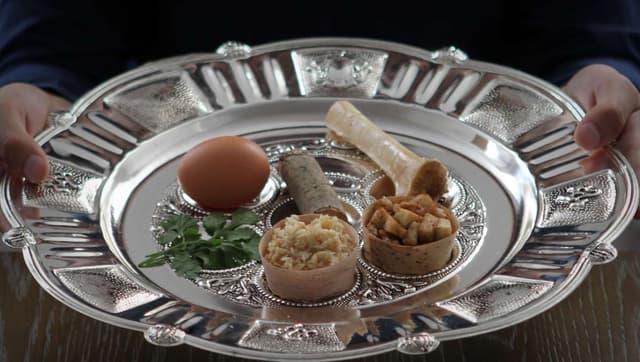
At this meal held with his disciples, we see the unleavened bread, or matzah (Luke 22:19; Ex. 12:18); the dip, probably the bitter herbs or maror (Mark 14:20; Ex. 12:8); and the cups (of wine; Luke 22:17, 20—these were a later tradition not found in the Old Testament). Of special interest is what Jesus said over the bread and the wine in Luke 22:19–20:
And He took bread, gave thanks and broke it, and gave it to them, saying, “This is My body which is given for you; do this in remembrance of Me.” Likewise He also took the cup after supper, saying, “This cup is the new covenant in My blood, which is shed for you.”
Matthew is more explicit about the meaning of the cup: “Then He took the cup, and gave thanks, and gave it to them, saying, ‘Drink from it, all of you. For this is My blood of the new covenant, which is shed for many for the remission of sins’” (Matt. 26:27–28). Jesus, then, spoke about the matzah and wine as referring to his own body and blood, which he connected with his atoning death for the forgiveness of sins. It’s interesting that in some Jewish traditions, the wine is supposed to be red to remind us of the blood of the Passover lamb.
Jesus, then, spoke about the matzah and wine as referring to his own body and blood.
In making this connection at Passover, Jesus was speaking of another redemption soon to occur: not the deliverance from Egypt, but deliverance from sin and death through his atoning sacrifice. The Passover meal was a picture or type of the redemption Jesus brought.
Of course, Passover and the Exodus were not merely patterns for the future. God used those historic events to establish his people, Israel. As such, the original Passover and Exodus remain a source of identity for contemporary Jewish people to remember every year, as well as offering vital teaching for the church. What God did in history came to its fulfillment in Jesus the Messiah, but those acts of God retain in themselves powerful lessons on God, his power, his faithfulness in fulfilling his promises, and much more.
Time and time again, Jesus claimed to fulfill God’s promise of a Messiah, as shown in the Tanakh. If he didn’t, then no one should follow him—Jewish or not. But if Jesus was right, he is the key to understanding God’s plan to redeem and renew all things. And he is the key to understanding the ultimate freedom that his last Passover made possible.
Related Articles


Subscribe
Get new monthly articles and special invitations in your inbox!