
Do Jews Believe in an Afterlife? Do You?
Exploring the traditional Jewish belief in the Olam ha-Ba (the world to come).
by Rich Robinson |
The afterlife is apparently a trending topic right now. The New York Times Magazine headlined a recent article, “Why Do Movies Keep Repeating the Same Joke About the Afterlife?”1 The movies’ joke, per the article, is “What if the next world worked just like this one?” In contrast, some older movies show us “an afterlife that is meaningful but resembles nothing of the world we’ve known.”
Which ending do you prefer? No afterlife? An afterlife just like this one? Or an afterlife completely different from anything you’ve ever experienced? Or would you just like to be surprised?
Everyone is free to have their own opinions on the subject. But what if our ideas aren’t exactly right?
When a Category 5 hurricane rolls into Florida, there are always some people who opt not to evacuate. Whatever happens, they say, it can’t be as bad as they are making it out to be. There’s a name for this kind of thinking: “normalcy bias.” We’re naturally resistant to the idea that the unknown future could hold extreme danger.
This cognitive bias seems to be especially operative in our thinking about the afterlife. Whatever happens beyond the horizon2 can’t be all that important . . . right? And if you’re a Jewish person thinking about what comes next, don’t most Jewish people have no belief in the afterlife anyway?
For Reform Jews (the branch of Judaism I was raised in), that last statement is generally true. But for your Uncle Morrie in the Orthodox synagogue down the street, the afterlife may well be a real part of his more traditional belief.
And incidentally, like other rabbis of his day, Jesus also thought the afterlife was pretty important—even more important than a Category 5 hurricane barreling toward your home.
Enroll for free access to online courses and hear from seasoned ministers! You’ll learn the scriptural foundation and practical challenges of Jewish evangelism and be better equipped to share the love of Yeshua in a culturally appropriate way.

What Jewish People Are “Supposed to” Believe about
the Olam ha-Ba
Poll Jewish people today as to whether they believe in an afterlife and you’re likely to get responses such as:
- “We’ll find out when it happens.”
- “I’ll live on in my children and grandchildren.”
- “As long as there’s someone to say Kaddish3 for me.”
- “Who knows? Now, where do you want to eat for dinner?”
This seems to be the majority Jewish view: this world is it. Or to phrase it more cynically, the World to Come already came.
But traditional (especially those among the Orthodox) will be more certain. For them, there is indeed an afterlife, called the Olam ha-Ba, the World to Come. It’s true, Jewish people of all stripes are more interested in how to live in the here and now. But ideas of an afterlife are part of Judaism. They are the kinds of ideas Jews “are supposed to have” if only they were more traditional.
The grassroots religious leaders emphatically believed in a life beyond death.
But even traditional Jews do not always agree on the subject (what else is new?) Go back a couple of thousand years to first-century Israel, and Jewish people were similarly divided on the topic of the afterlife—specifically on the issue of whether there would be a resurrection of the dead at the end of time. The no-afterlife/no-resurrection view was then the minority opinion and was mostly held by the wealthy priestly class in Jerusalem known as Sadducees. The more numerous grassroots religious leaders of the common people, the Pharisees, emphatically believed in a life beyond death.
Jesus, the Bible, and the Olam ha-Ba
One reason that Jewish people then (as now) held different views was that the Jewish Bible doesn’t seem to talk much about the world to come. It does though, offer a few glimpses, especially in the Prophets.
Isaiah 26:19 is probably the oldest text of the Bible we have that describes an explicit hope for resurrection. And the final chapters of that book have a lot to say about a renewed world of peace coming in the future.4
For behold, I create new heavens and a new earth.
The former things will not be remembered or come to mind.
But be glad and rejoice forever in what I am creating.
I will rejoice in Jerusalem and be glad in my people;
no more shall be heard in it the sound of weeping and the cry of distress.The wolf and the lamb shall graze together;
the lion shall eat straw like the ox,
and dust shall be the serpent’s food.
They shall not hurt or destroy in all my holy mountain.Says the Lord.
Other prophets follow Isaiah in seeing the hope of resurrection as part of a future time, which included God’s judgment against sin. Daniel 12:2, for instance, says:
Many of those who sleep in the dust of the earth shall awake, some to everlasting life, and some to shame and everlasting contempt.
After the time of the Tanakh, Jewish ideas about the afterlife took clearer shape. One Jewish text called the Book of Enoch, not part of the Bible, comes from around a century before Jesus. It says:
There shall be the great eternal judgement, in which [God] will execute vengeance amongst the angels.
And the first heaven shall depart and pass away.
And a new heaven shall appear.
And all the powers of the heavens shall give sevenfold light.
And after that there will be many weeks without number for ever. And all shall be in goodness and righteousness.
And sin shall no more be mentioned forever.5(Book of Enoch, chapter 91)
By Jesus’ time, most Jewish people believed not only that there was a life after this one—they believed that people would someday literally rise from death bodily. This is the cultural reality into which Jesus came teaching around 30 AD.
Jesus and the New Testament authors carried these Jewish expectations forward so that the existence of an afterlife comes through loud and clear. For instance, we have a story from the New Testament’s Gospel of John. In it, a man named Lazarus has died. Jesus makes his way to their hometown of Bethany in Judea, but
When Jesus came, he found that Lazarus had already been in the tomb four days. Bethany was near Jerusalem, about two miles off, and many of the Jews had come to Martha and Mary to console them concerning their brother.
So when Martha heard that Jesus was coming, she went and met him, but Mary remained seated in the house.
Martha said to Jesus, “Lord, if you had been here, my brother would not have died. But even now I know that whatever you ask from God, God will give you.”
Jesus said to her, “Your brother will rise again.”
Martha said to him, “I know that he will rise again in the resurrection on the last day.”
Jesus said to her,
“I am the resurrection and the life. Whoever believes in me, though he die, yet shall he live, and everyone who lives and believes in me shall never die. Do you believe this?”
She said to him, “Yes, Lord; I believe that you are the Messiah, the Son of God, who is coming into the world.”
In the story, Jesus goes on to raise Lazarus from the dead.6 But notice Martha’s comment, “I know that he will rise again in the resurrection on the last day,” was the common Jewish hope and belief. And then notice Jesus’ response:
“I am the resurrection and the life. Whoever believes in me, though he die, yet shall he live, and everyone who lives and believes in me shall never die.”
Judaism has often been contrasted with Christianity. Christians, it is said, focus on the next world, but Jews are different. We are concerned with how to live now, with making this world a better place, not escaping from it into some future life. It’s escapism vs. tikkun olam,7 to put it in modern terms. The choice is supposedly between abandoning this world for the next or taking care of the world we’re living in now.
However, this stereotyped contrast doesn’t stand. Like a lot of things, it’s not a matter of either/or but both/and. We can care for our cities, our people, the natural world and still put our hope in a world that has yet to arrive.8
Do People Go to Heaven? Should We Even Care?
A popular view of the place commonly called “heaven” is that of people sitting on clouds, dressed in white robes, and playing the harp. Let me be honest—if I thought that’s what the afterlife is, I’d be in no hurry to go there. In a completely different conception, Jesus and the New Testament talked about the Jewish hope for physical resurrection and this world being renewed by God.
Do they want to sit on clouds and play the harp?
So why do so many Christians talk about “going to heaven” when they die? Do they want to sit on clouds and play the harp? (As a variant on an old joke: “Doctor, after my arm is healed, will I be able to play the harp?” “Yes, without a problem.” “That’s great! Because I could never play it before!”)
But an afterlife that is a positive place also has roots in the Tanakh. The idea was that righteous people who died would come into the presence of Abraham and their forefathers. In 2 Kings 22:20, God says to the king of Judah, “Therefore, behold, I will gather you to your fathers, and you shall be gathered to your grave in peace.”9 Jesus also alludes to this in his parable of Lazarus and the rich man (Luke 16:19–31), a story about a poor man who dies and “was carried by the angels to Abraham’s side.”
Jesus also calls this place after death “Paradise” in Luke 23:43, a direct reference to the Garden of Eden.10 And in John 14:2–3 (New American Standard translation), he talks about “dwelling places” in his Father’s house, that is, God’s house.
What would such a place be like? Paul the apostle, quoting Isaiah 64:4, says that “What no eye has seen, nor ear heard, nor the heart of man imagined, what God has prepared for those who love him …” (1 Corinthians 2:9). In other words, it’s a place in the presence of God—but beyond that, who can say?
The best clue as to what “heaven” is like is in the New Testament near the end of the book of Revelation (a book that is more Jewish than many think). In the description of the world’s renewal, a new Jerusalem descends from heaven to earth (Revelation 21:1–4). People then live on the renewed earth which has come down from heaven. In other words, the biblical picture is one of the renewal of this planet, in which God himself is present. But it is not a picture of people moving from earth to heaven. No clouds, no harps. Just a brand-new earth filled with God’s presence.
The Question that Dare Not Say Its Name:
Do People Go to Hell?
The flip side of a positive afterlife is, well, a negative one. Probably everyone has heard at one time or another some preacher, billboard, or social media post saying that without Jesus, “you’re going to hell.”
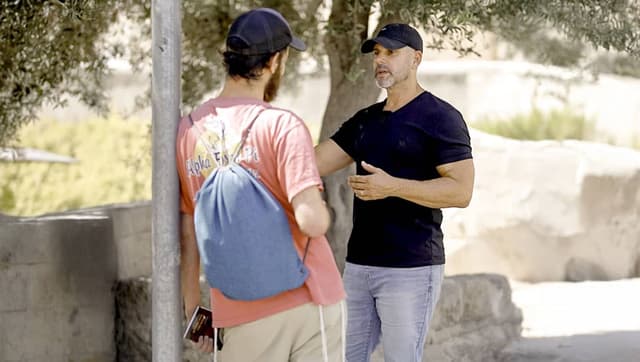
When I worked on Wall Street as a teenager—I was a messenger, not a teenage entrepreneurial billionaire—there were people who would preach right on the street. Sometimes they would yell at passers-by, “You’re going to hell!” (I remember one person challenging the preacher, “What do you do for a living?” as if to imply that he was an out-of-work guy who liked to yell at people. The preacher literally yelled back, “I MAKE ICE CREAM!” Only in New York.)
But what about a negative afterlife? Is there really a hell? And how does that square with a God of love? Let me offer a few thoughts:
It’s clear that these images are describing aspects of a life apart from God. Remember that Paul, quoted above, said, “What no eye has seen, nor ear heard, nor the heart of man imagined, what God has prepared for those who love him …” I believe the same applies to a negative afterlife, to hell. We really cannot know, other than that God is missing from someone’s life at that point.
This also applies to the idea that people are in hell “forever.” God, it seems, is beyond time, since he created time itself. “Forever” in that context is not something we can really understand.
3. We all innately want to see justice done in the universe. We innately want someone like Hitler to be punished for his actions. The extreme cases are easy. What about “regular” people who, let’s say, steal or deal drugs, leading to the death of others? What about people who don’t do any of that but are “pretty good”? This leads on to the next point.
4. Scripture says that we all sin, and no one is sinless. Every year, Yom Kippur, the day of atonement, comes around to remind us of this fact and the need to repent and turn back to God. If you attend Yom Kippur services, you might notice that there are a lot of “regular” people there who might even be upstanding members of their community. Yet there they are to confess their own sins and the sins of the community.
That’s one reason Israel had a sacrificial system in ancient times. Our sin was atoned for by the death of an animal, which only goes to show how seriously sin was taken. Today, of course, we no longer sacrifice, but we repent, pray, do deeds of charity, and fast. Sin is still something to be taken seriously, even by the “best of us.”
5. Some people may not think they have any sin at all. Some deliberately push God away. I don’t know why some people do these things. Only God knows their hearts. But for those who do choose to go without recognizing God or the need for their own repentance, God honors that choice. Being apart from God—that is the result of what Scripture calls God’s judgment. It is hell.
The More Important Question
The real question is, is there a future world? Will there be an Olam ha-Ba, a new Jerusalem, a new creation, a renewal of all things? And will there be the opposite?
It confirms that our Jewish ancestors were right.
A core claim of the New Testament is that for followers of Jesus, the future world has already begun to appear in the present one. It became manifest when, following his death by crucifixion, Jesus rose from the dead into a new life. (For reasons to believe the resurrection happened in history see Resurrection: Rabbinic Judaism, Hebrew Scripture and the New Testament)
And if it did happen, it confirms that our Jewish ancestors were right, there is life beyond death.
And if the resurrection is real, that tells us that the coming day of judgment must be real as well.
It also means that we need to ask what we should be doing to prepare for the afterlife—even while we are still embedded in the here-and-now of this world.
Recall the conversation in John:
“Whoever believes in me, though he die, yet shall he live, and everyone who lives and believes in me shall never die. Do you believe this?” She said to him, “Yes, Lord; I believe that you are the Messiah, the Son of God, who is coming into the world.”
Subscribe to get our monthly About Jesus email and 12 Reasons for Jewish Faith in Jesus!A resource for you!

Endnotes:
1. Scott Brobst, “Why Do Movies Keep Repeating the Same Joke About the Afterlife?,” New York Times Magazine, December 17, 2025.
2. As Bob Dylan called it in a song from back in the aughts.
3. Hebrew prayer recited when someone dies and regularly in memory of them. Popularly said to be a “prayer for the dead,” but it is a prayer praising God.
4. See all of Isaiah chapters 60–62 and 65–66.
5. The Book of Enoch: Chapter 91
6. This was different than the expected end-of-time resurrection of people, which would usher them into eternal life. Lazarus apparently went on to die like other people; Jesus accomplished more of a resuscitation than a resurrection.
7. Literally, “repair of the world,” today often used to mean social action or making this world a better place for its inhabitants.
8. Writer C.S. Lewis once claimed, “If you read history, you will find that the Christians who did most for the present world were precisely those who thought most of the next.”
9. Beyond the Tanakh, see 4 Maccabees 13:14–18. “…For if we so die, Abraham and Isaac and Jacob will welcome us, and all the fathers will praise us…”
10. The Greek word paradeisos (paradise) simply means “garden.” But it was used in the Septuagint for the Garden of Eden, which is the reference Luke would have expected his readers to pick up.
Related Articles


Subscribe
Get new monthly articles and special invitations in your inbox!