Three Thanksgiving Parades
How three celebrations remind us to give thanks
by Rich Robinson |
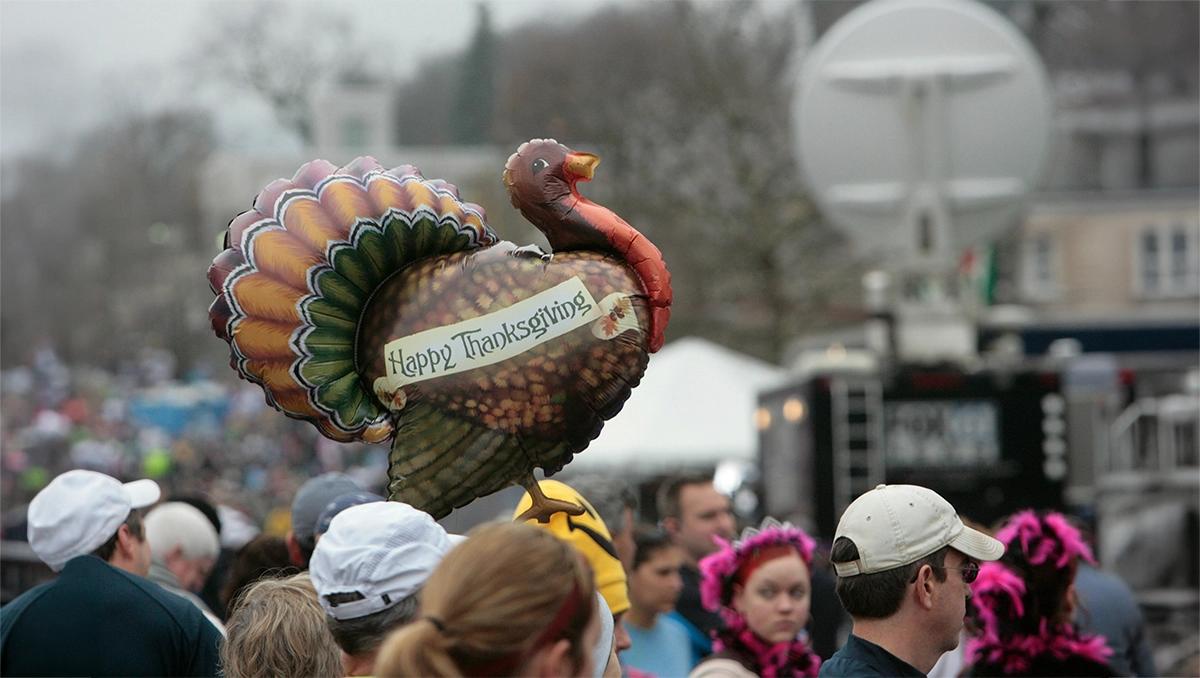
It’s almost Thanksgiving again, and that means it’s time for the annual Macy’s Thanksgiving Day parade in New York City. Though the world’s largest parade started in 1924, it was cancelled during World War II (from 1942–1944).1 So, this year marks its 100th anniversary.
Whether watching the parade or not, we may get sick of answering for what feels like the 100th time the question that makes its way into every conversation this time of year: “So, what are you thankful for?” But rather than brush it off, we thought we’d lean into it. There are reasons to be thankful: at least three that I can think of, and each one can be seen by looking at one of three “Thanksgiving parades.”
Firstly, the Macy’s Thanksgiving Parade itself invokes ideas of home, family, and food—all American as well as Jewish values. All elements that have helped make Thanksgiving a sort of “secular seder” for Jewish people (at least as far as the meal is concerned).
Interestingly, this parade was heavily influenced by Macy’s employees, who in the old days were mostly European immigrants. How many Jewish people could have been among those immigrants?
For those first American Jews, Thanksgiving must have been especially meaningful. Not only did the holiday symbolize all the reasons they’d come to America in the first place, but it also gave them a chance to integrate with their new community, their new home.
So, if you watch the Macy’s parade this year, be thankful that America provided a safe haven for Europe’s Jews, allowing them to set down roots here. If the first immigrant generation often languished in tenements and worked bone-breaking hours, their children and grandchildren have come to enjoy the fruits of America’s provision. For Jews, that’s a real occasion to give thanks!
The Bible also tells of a thanksgiving parade—but at Purim. Purim is the winter festival celebrating the Jews’ deliverance from Haman’s attempted genocide. Purim plays, or purimshpiels, are a prominent feature of the holiday. And the sixth chapter of the book of Esther—which is read in its entirety on Purim—lets us in on this most unusual parade.
Here’s the story: it seems that King Ahasuerus learned that Mordecai, one of the Jewish heroes of the book of Esther, had prevented an attempt on the king’s life. The king, realizing that nothing had been done to honor Mordecai for his deed, sees Haman entering the palace. Ironically, Haman was about to speak to the king about having Mordecai hanged for refusing to bow down to him (Haman)!
Here’s what the parade looked like:
The king said to Haman, “Hurry; take the robes and the horse … and do so to Mordecai the Jew, who sits at the king’s gate. Leave out nothing that you have mentioned.”
So Haman took the robes and the horse, and he dressed Mordecai and led him through the square of the city, proclaiming before him, “Thus shall it be done to the man whom the king delights to honor.”
Then Mordecai returned to the king’s gate. But Haman hurried to his house, mourning and with his head covered. (Esther 6:10–12)
That is a thanksgiving parade of its own. Because after all, Purim along with Passover can be thought of as a kind of Jewish Thanksgiving on which we celebrate God’s deliverance of the Jewish people from antisemitic acts and plots.
In surviving, we find the seeds for flourishing. That’s something to be thankful for!
This story reminds us to give thanks for our continued survival. Of course, Jewish life is about far more than just surviving. In surviving, though, we find the seeds for flourishing. That’s something else to be thankful for!
There’s another parade of thanks, if you will, mentioned in the New Testament, and it’s about that ultimate flourishing. In fact, it’s a fulfillment of the flourishing and tikkun olam that were promised in the Hebrew Scriptures.
Paul, the Jewish ambassador to the Gentiles, wrote to a congregation in the city of Corinth:
But thanks be to God, who in Messiah always leads us in triumphal procession, and through us reveals everywhere the aroma of the knowledge of Himself. (2 Corinthians 2:14, TLV)
About this passage, Bible scholar Craig Keener says:
Roman conquerors would lead their shamed captives in a “triumphal procession.” Messiah had triumphed and now led believers in him as his captives (the image is similar to that of being Messiah’s servants). … The Roman senate normally decreed public thanksgivings before the triumphal processions, so they were great celebrations for the victors and great humiliations for the defeated.
But Paul glories in the image of Messiah-followers as peoples taken captive by Messiah … and this prisoner of war himself offers the thanksgiving! 2
Here we have another parade not just with one person (like with Mordecai) or even with thousands (as in the Macy’s parade), but with a multitude of those who have decided to follow Jesus as their Messiah. This parade is a mirror image of the parades of the Roman oppressors. But here, the followers of Messiah are thankful that they are following God, not Rome. There is no humiliation but only the giving of thanks.
Followers of Jesus are thankful that they are no longer under the oppression of sin but are free. The parade that the Messiah metaphorically leads us in is not that of humiliated captives but of free people.
***
The “what are you thankful for” question may seem forced or may even wear us out by the end of the month. Yet there’s a reason we keep coming back to it. Seeing the things we’re thankful for, beyond the turkey and cranberry, helps us cultivate an outlook on life that allows us to be people who bring shalom into the world—and this Thanksgiving, isn’t that something we all want more of?
Endnotes
1 “Macy’s Thanksgiving Day Parade,” Wikipedia, accessed October 27, 2026.
2 Craig Keener, The IVP Bible Background Commentary: New Testament (Downers Grove, IL: IVP Academic, 1993), using Oak Tree Software electronic version 2.2. Some of Keener’s wording has been modified to underscore the Jewishness of what Paul is saying (e.g., Messiah instead of Christ).
Related Articles

Subscribe
Get new monthly articles and special invitations in your inbox!